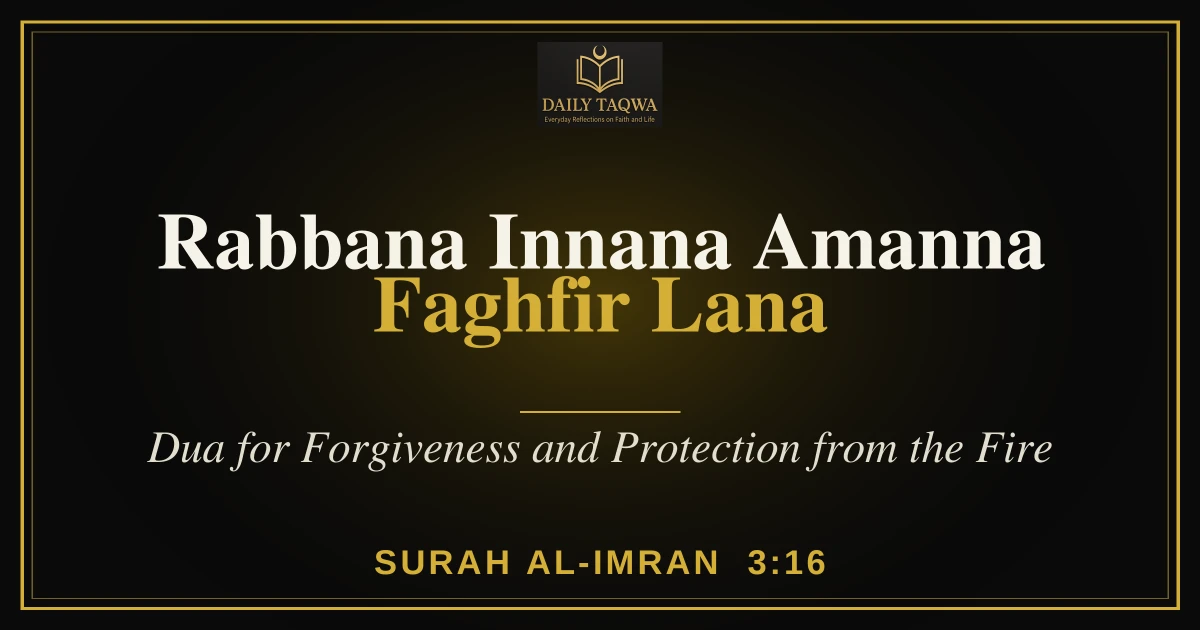
Rabbana innana amanna faghfir lana dhunubana wa qina ‘adhaban-nar is a dua from Surah Al-Imran, verse 16. It means: ‘Our Lord, indeed we have believed, so forgive us our sins and protect us from the punishment of the Fire.’
In this dua, a believer first says that he has believed, and then asks Allah for two things: forgiveness for his sins and safety from the Fire. Below you will find the Arabic, Roman English, Hindi and Urdu, the meaning of each word, who says this dua in the Quran, the best time to make it, and the authentic Hadith that connect to it.
رَبَّنَا إِنَّنَا آمَنَّا فَاغْفِرْ لَنَا ذُنُوبَنَا وَقِنَا عَذَابَ النَّارِ
Roman English
Rabbanaa innanaa aamannaa faghfir lanaa dhunoobanaa wa qinaa ‘adhaaban-naar.
Hindi (हिन्दी)
रब्बना इन्नना आमन्ना फ़ग़्फ़िर लना ज़ुनूबना व क़िना अज़ाबन्-नार।
ऐ हमारे रब! हम ईमान ले आए, तो हमारे गुनाह माफ़ कर दे और हमें आग के अज़ाब से बचा ले।
Urdu (اردو)
اے ہمارے رب! ہم ایمان لے آئے، پس ہمارے گناہ معاف فرما دے اور ہمیں آگ کے عذاب سے بچا لے۔
Meaning in English
Our Lord, indeed we have believed, so forgive us our sins and protect us from the punishment of the Fire.
Quran Reference
- Surah: Al-Imran (Chapter 3), verse 16
- Read online: Quran 3:16 on Quran.com
- Context: Quran 3:15 to 3:17, a description of the people who are mindful of Allah
What Does Rabbana Innana Amanna Faghfir Lana Mean?
The dua has four short parts:
- Rabbana – our Lord
- Innana amanna – indeed we have believed
- Fa-ghfir lana dhunubana – so forgive us our sins
- Wa qina ‘adhaban-nar – and protect us from the punishment of the Fire
The word ‘fa’ (so) in ‘fa-ghfir’ connects the two halves: because we believed, we ask for forgiveness. Tafsir Ibn Kathir explains ‘we have believed’ as belief in Allah, in His Book and in His Messenger. It explains ‘so forgive us our sins’ as: because of our faith in You and in what You have legislated for us, forgive our errors and shortcomings with Your bounty and mercy.
Notice that we do not say ‘we have done enough good’. We say ‘we have believed’ and then ask for forgiveness. We ask from Allah’s mercy, not from our own deeds.
Who Says This Dua in the Quran?
Quran 3:15 tells us that those who are mindful of Allah will have Gardens with their Lord, with rivers flowing under them, where they will stay forever, with pure spouses and Allah’s pleasure. Quran 3:16 says that these are the people who say this dua. Then Quran 3:17 describes them as:
- patient
- sincere (true in faith, words and deeds)
- obedient to Allah
- charitable, spending in the way of Allah
- those who pray for forgiveness before dawn
So this dua is not only words. In the Quran, it is the dua of people who also try to live by their faith: they are patient, truthful, obedient and generous. This is a good reminder for us to make the dua and also work on these qualities.
What Does the Authentic Hadith Say?
The two Hadith below are not explanations of verse 3:16 itself. They connect to what verse 3:17 says about asking forgiveness before dawn and about Allah’s wide forgiveness.
1. Allah calls His servants in the last third of the night. In Sahih Al-Bukhari 1145 (also in Sahih Muslim 758), Abu Hurairah (may Allah be pleased with him) reported that the Messenger of Allah (peace and blessings be upon him) said that our Lord descends every night to the nearest heaven when the last third of the night remains, and says: ‘Who is calling upon Me so that I may answer him? Who is asking Me so that I may give him? Who is seeking My forgiveness so that I may forgive him?’ Believers accept these words as they came, and only Allah knows how.
References: Sahih Al-Bukhari 1145 and Sahih Muslim 758
2. Allah’s forgiveness is wide. In Jami at-Tirmidhi 3540, Anas (may Allah be pleased with him) reported that the Messenger of Allah (peace and blessings be upon him) said that Allah says: ‘O son of Adam, as long as you call upon Me and hope in Me, I will forgive you for what you have done, and I do not mind. O son of Adam, if your sins reach the clouds of the sky and you ask My forgiveness, I will forgive you. O son of Adam, if you come to Me with sins nearly as great as the earth, and then meet Me without associating anything with Me, I will bring you forgiveness nearly as great as it.’ It is graded Hasan.
Reference: Jami at-Tirmidhi 3540
When Is the Best Time to Make This Dua?
You can make this dua at any time, because Allah invites us to call upon Him (Quran 40:60). But the Quran and the Hadith above point to one special time: before dawn. Quran 3:17 praises those who seek forgiveness before dawn, and Sahih Al-Bukhari 1145 mentions the last third of the night.
How do you find the last third of the night? The night starts at sunset and ends at dawn. Divide that time into three equal parts. For example, if the night is 9 hours long, the last third is the last 3 hours before Fajr.
Benefits and Lessons
- Say your faith first, then ask. The dua begins with ‘we have believed’.
- Ask for forgiveness and safety together. We ask Allah to forgive our sins and protect us from the Fire.
- Be patient and regular. The people in Quran 3:17 are described as patient. For a dua about patience, see Rabbana Afrigh Alayna Sabran.
- Make a habit of seeking forgiveness before dawn. This is the time praised in Quran 3:17.
- Do not lose hope. The Hadith in Tirmidhi 3540 shows how wide Allah’s forgiveness is.
Similar Duas for Forgiveness in Surah Al-Imran
Some websites mix up the verse numbers of these duas, so it helps to know the difference:
- Quran 3:16 – Rabbana innana amanna faghfir lana dhunubana wa qina ‘adhaban-nar. We say we have believed, and ask for forgiveness and protection from the Fire.
- Quran 3:147 – Rabbana ighfir lana dhunubana wa israfana fi amrina wa thabbit aqdamana wansurna ‘alal-qawmil-kafirin. We ask forgiveness for our sins and for our excess in our affairs, and ask for firm feet and help.
- Quran 3:193 – Rabbana faghfir lana dhunubana wa kaffir ‘anna sayyi’atina wa tawaffana ma‘al-abrar. We ask forgiveness for our sins, to remove our misdeeds, and to die with the righteous.
For the dua about forgetfulness and mistakes, see Quran 2:286.
Frequently Asked Questions
What does Rabbana innana amanna faghfir lana mean?
It means: Our Lord, indeed we have believed, so forgive us our sins and protect us from the punishment of the Fire. The believer first states his faith, and then asks Allah for forgiveness and safety from the Fire.
Where is Rabbana innana amanna faghfir lana in the Quran?
It is in Surah Al-Imran (Chapter 3), verse 16.
Who says this dua in the Quran?
Quran 3:15 to 3:17 describes those who are mindful of Allah. They say this dua, and Allah describes them as patient, sincere, obedient, charitable, and those who ask forgiveness before dawn.
When is the best time to say this dua?
You can say it at any time. Quran 3:17 praises those who seek forgiveness before dawn, and Sahih Al-Bukhari 1145 and Sahih Muslim 758 mention the last third of the night as the time when Allah calls His servants to ask Him and to seek His forgiveness.
Is ‘warhamna’ part of this dua?
No. Some websites add ‘warhamna’ (and have mercy on us) after ‘faghfir lana’, but these words are not in Quran 3:16. The word ‘warhamna’ appears in other verses, such as Quran 2:286.
Is this dua the same as the duas in Quran 3:147 and 3:193?
No. They are three different duas in the same Surah. Quran 3:16 declares faith and asks for forgiveness and protection from the Fire. Quran 3:147 and Quran 3:193 have different words and different requests, as shown in the list above.
Is there a fixed reward or number of times to recite it?
We have not found an authentic Hadith that sets a number or a special reward for reciting only this dua. Some websites recommend reciting it daily or after every prayer. This is not verified as a fixed practice.
Are the Hindi and Urdu lines the Quran?
No. The Arabic is the word of Allah. The Roman English, Hindi and Urdu lines are only to help you read and understand. Please learn the correct pronunciation from a qualified teacher.
More Duas for Forgiveness and a Good End
- Rabbana Atina Fid Dunya Hasanah (Quran 2:201)
- Dua for Guidance: Ihdinas Siratal Mustaqeem (Quran 1:6–7)
References
- Quran 3:15–17 and its tafsir by Ibn Kathir – quran.com/3/16
- Quran 3:147, 3:193, 40:60 and 2:286
- Sahih Al-Bukhari 1145 – sunnah.com/bukhari:1145
- Sahih Muslim 758
- Jami at-Tirmidhi 3540 – sunnah.com/tirmidhi:3540
Conclusion
This short dua teaches us a complete way of asking: say that you believe, ask Allah to forgive your sins, and ask Him to keep you safe from the Fire. The Quran links it with patience, truthfulness, obedience, charity and asking forgiveness before dawn.
May Allah forgive our sins, protect us from the Fire and make us among those who are mindful of Him. Ameen.