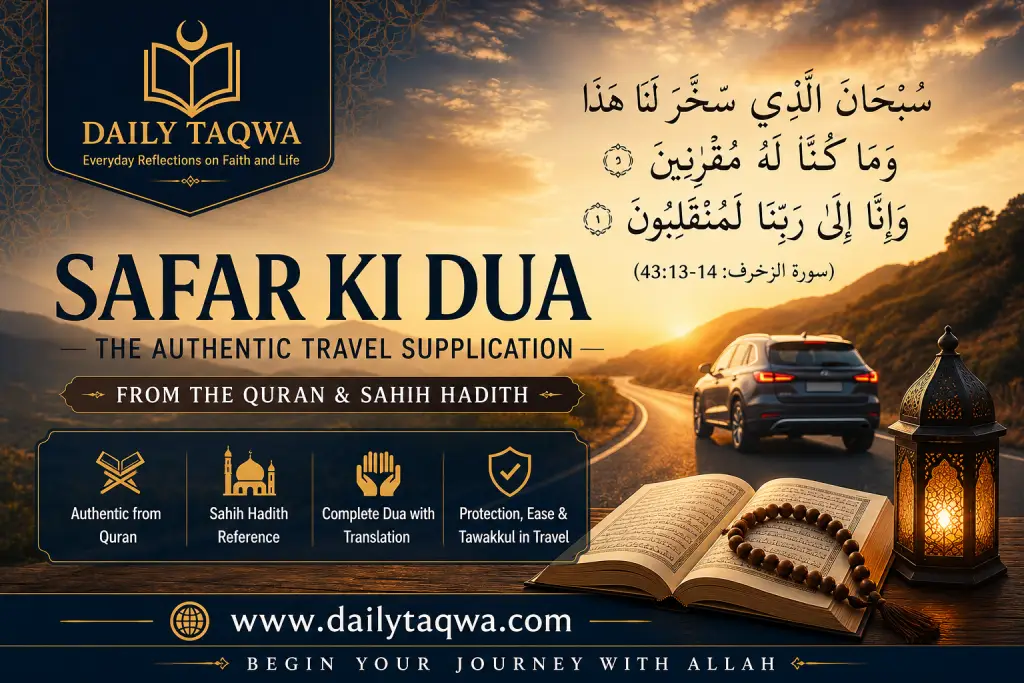
Travel is a part of life. Whether we travel for work, education, family visits, Hajj, Umrah, or leisure, Islam teaches us to begin every journey by remembering Allah. The Prophet Muhammad ﷺ never relied solely on preparation and planning; rather, he placed his complete trust (Tawakkul) in Allah while taking the necessary means.
The famous Safar Ki Dua is not merely a prayer for protection. It is a comprehensive supplication that combines gratitude, reliance upon Allah, righteousness, ease, and protection from every hardship during travel. It is firmly established in the Quran and authentic Hadith.
In this article, we will explore the authentic Safar Ki Dua with its Arabic text, transliteration, translation, references from the Quran and Sahih Hadith, and the etiquettes of traveling according to Islam.
What is Safar Ki Dua?
Safar Ki Dua (Supplication for Travel) is the dua that the Prophet Muhammad ﷺ recited whenever he mounted an animal for travel. Today, this Sunnah applies equally when boarding a car, bus, train, airplane, ship, or any other means of transportation.
The opening part of this dua comes directly from the Quran, while the remaining supplication is authentically narrated in Sahih Muslim.
Quranic Foundation of Safar Ki Dua
Allah says:
“Glory be to Him Who has subjected this to us, and we could never have accomplished it ourselves. And indeed, to our Lord we will surely return.”
Arabic
سُبْحَانَ الَّذِي سَخَّرَ لَنَا هَذَا وَمَا كُنَّا لَهُ مُقْرِنِينَ وَإِنَّا إِلَىٰ رَبِّنَا لَمُنقَلِبُونَ
Reference: Surah Az-Zukhruf (43:13-14).
These verses remind every believer that no vehicle, technology, or human effort has independent power. Every means of transport is under Allah’s control.
The Complete Authentic Safar Ki Dua
The Prophet ﷺ would first say:
Allahu Akbar (three times)
Then recite:
Arabic
اللَّهُ أَكْبَرُ، اللَّهُ أَكْبَرُ، اللَّهُ أَكْبَرُ
سُبْحَانَ الَّذِي سَخَّرَ لَنَا هَذَا وَمَا كُنَّا لَهُ مُقْرِنِينَ وَإِنَّا إِلَى رَبِّنَا لَمُنْقَلِبُونَ
اللَّهُمَّ إِنَّا نَسْأَلُكَ فِي سَفَرِنَا هَذَا الْبِرَّ وَالتَّقْوَى، وَمِنَ الْعَمَلِ مَا تَرْضَى.
اللَّهُمَّ هَوِّنْ عَلَيْنَا سَفَرَنَا هَذَا، وَاطْوِ عَنَّا بُعْدَهُ.
اللَّهُمَّ أَنْتَ الصَّاحِبُ فِي السَّفَرِ، وَالْخَلِيفَةُ فِي الْأَهْلِ.
اللَّهُمَّ إِنِّي أَعُوذُ بِكَ مِنْ وَعْثَاءِ السَّفَرِ، وَكَآبَةِ الْمَنْظَرِ، وَسُوءِ الْمُنْقَلَبِ فِي الْمَالِ وَالْأَهْلِ.
Transliteration
Allahu Akbar, Allahu Akbar, Allahu Akbar.
Subhanalladhi sakhkhara lana hadha wa ma kunna lahu muqrinin wa inna ila Rabbina lamunqalibun.
Allahumma inna nas’aluka fi safarina hadhal birra wat-taqwa wa minal ‘amali ma tarda.
Allahumma hawwin ‘alayna safarana hadha watwi ‘anna bu’dahu.
Allahumma antas-sahibu fis-safari wal-khalifatu fil-ahli.
Allahumma inni a’udhu bika min wa’tha’is-safari wa ka’abatil-manzari wa su’il-munqalabi fil-mali wal-ahli.
English Meaning
“O Allah, You are the Greatest.
Glory is to Him Who has subjected this transport to us, though we could never have controlled it ourselves, and surely to our Lord we will return.
O Allah, we ask You during this journey for righteousness, piety, and deeds that please You.
O Allah, make this journey easy for us and shorten its distance.
O Allah, You are our Companion during the journey and the Guardian over our family.
O Allah, I seek refuge in You from the hardships of travel, distressing sights, and an unfortunate return concerning wealth and family.”
Authentic Reference: Sahih Muslim (Book of Dhikr and Du’a).
Dua When Returning Home
Upon returning from travel, the Prophet ﷺ would recite the same dua and add:
Arabic
آيِبُونَ تَائِبُونَ عَابِدُونَ لِرَبِّنَا حَامِدُونَ
Transliteration
Aayiboona, taa’iboona, ‘aabidoona, lirabbina haamidoon.
Meaning
“We return, repenting, worshipping, and praising our Lord.”
Reference: Sahih Muslim.
Another Authentic Dua Before Leaving Home
Before stepping outside the house, the Prophet ﷺ taught another authentic supplication:
Arabic
بِسْمِ اللَّهِ، تَوَكَّلْتُ عَلَى اللَّهِ، وَلَا حَوْلَ وَلَا قُوَّةَ إِلَّا بِاللَّهِ
Transliteration
Bismillah, tawakkaltu ‘alallah, wa la hawla wa la quwwata illa billah.
Meaning
“In the Name of Allah. I place my trust in Allah. There is no power and no strength except through Allah.”
The Prophet ﷺ said that whoever recites this will be told:
- You are guided.
- You are protected.
- You are safeguarded.
Reference: Sunan Abu Dawud (authenticated by scholars).
Sunnah Etiquettes of Traveling
Along with reciting Safar Ki Dua, the Sunnah teaches several beautiful etiquettes:
- Begin the journey by remembering Allah.
- Pray two rak’ahs before leaving if possible.
- Choose righteous companions.
- Avoid unnecessary delay in returning after completing one’s purpose.
- Maintain good manners throughout the journey.
- Continue making dhikr and dua during travel.
- Remember that the supplication of a traveler is among the supplications that are accepted by Allah.
Why Does the Safar Ki Dua Begin with the Quran?
The travel dua starts with verses from Surah Az-Zukhruf because every journey is a reminder that:
- Allah alone controls all means of transportation.
- Human beings possess no independent power.
- Every journey eventually ends with the greatest journey—the return to Allah.
Thus, the believer begins every trip with gratitude, humility, and remembrance of the Hereafter.
Common Mistakes Regarding Safar Ki Dua
Many Muslims unknowingly practice customs that have no authentic basis. It is important to distinguish the Sunnah from cultural traditions.
Avoid:
- Believing a specific number of recitations is obligatory without evidence.
- Attributing fabricated virtues to the dua.
- Inventing special travel rituals not established in the Quran or authentic Sunnah.
- Thinking the dua alone replaces practical safety measures. Islam teaches believers to trust Allah while also taking lawful precautions.
The authentic Sunnah is sufficient and complete.
Benefits of Reciting Safar Ki Dua
While we do not claim benefits beyond what is established in the Quran and authentic Sunnah, the texts clearly show that this supplication:
- Strengthens reliance upon Allah.
- Seeks righteousness during travel.
- Asks Allah for ease in the journey.
- Requests protection for one’s family.
- Seeks refuge from travel hardships.
- Reminds the believer of the Hereafter.
- Begins the journey with remembrance of Allah instead of negligence.
Frequently Asked Questions
Can Safar Ki Dua be recited before boarding a flight?
Yes. The Sunnah applies whenever you board any means of transportation, including airplanes, cars, buses, trains, ships, and motorcycles.
Is the Safar Ki Dua mentioned in the Quran?
The opening verses are from Surah Az-Zukhruf (43:13–14), while the complete supplication is authentically narrated in Sahih Muslim.
Should children learn this dua?
Yes. Teaching children authentic daily duas is among the best ways to connect them with the Sunnah from an early age.
Can I read it in English if I cannot read Arabic?
It is best to learn the Arabic wording taught by the Prophet ﷺ. Until then, reading the transliteration and understanding its meaning can help you learn it correctly.
Conclusion
The Safar Ki Dua is one of the most comprehensive supplications taught by the Prophet Muhammad ﷺ. It begins with verses from the Quran, continues with an authentic prophetic supplication, and beautifully combines gratitude, Tawakkul, righteousness, protection, and remembrance of Allah.
Every journey—whether short or long—is an opportunity to revive this Sunnah. By reciting this authentic dua with sincerity and understanding, a Muslim begins every trip by placing complete trust in Allah while seeking His guidance, mercy, and protection.
May Allah make all our journeys easy, protect us and our families, grant us righteousness in every step, and return us safely. Ameen.