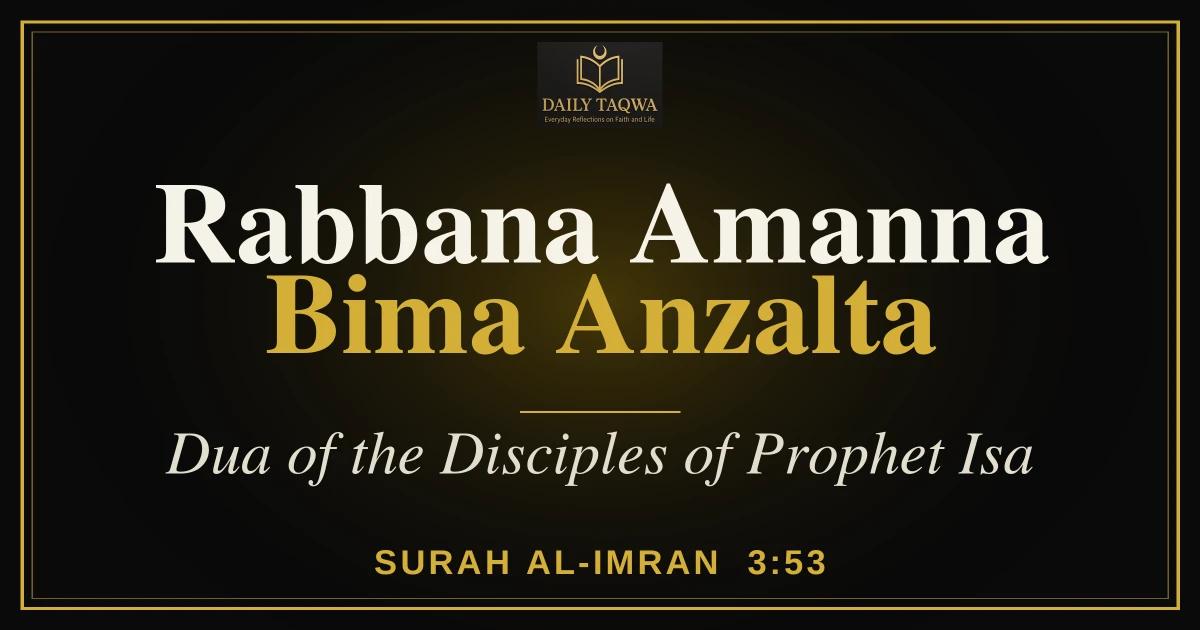
Rabbana amanna bima anzalta wattaba‘nar-rasula faktubna ma‘ash-shahidin is the dua of the Hawariyyun, the disciples of Prophet Isa (Jesus, peace be upon him), in Surah Al-Imran, verse 53. It means: ‘Our Lord, we have believed in what You have sent down and have followed the Messenger, so write us down among those who bear witness.’
This dua joins three things: belief in what Allah revealed, following the Messenger, and the wish to be counted among the witnesses of the truth. Below you will find the Arabic, Roman English, Hindi and Urdu, the meaning of each word, the story of the Hawariyyun, what ‘ash-shahidin’ means, and the authentic Hadith about the Hawari.
رَبَّنَا آمَنَّا بِمَا أَنزَلْتَ وَاتَّبَعْنَا الرَّسُولَ فَاكْتُبْنَا مَعَ الشَّاهِدِينَ
Roman English
Rabbanaa aamannaa bimaa anzalta wattaba‘nar-Rasoola faktubnaa ma‘ash-shaahideen.
Hindi (हिन्दी)
रब्बना आमन्ना बिमा अन्ज़ल्त वत्तबअ्नर्-रसूला फ़क्तुब्ना मअश्-शाहिदीन।
ऐ हमारे रब! जो कुछ तूने उतारा हम उस पर ईमान लाए और हमने रसूल की पैरवी की, तो हमें गवाही देने वालों (सच के गवाहों) में लिख ले।
Urdu (اردو)
اے ہمارے رب! جو کچھ تو نے نازل کیا ہم اس پر ایمان لائے اور ہم نے رسول کی پیروی کی، پس ہمیں گواہی دینے والوں (حق کے گواہوں) میں لکھ لے۔
Meaning in English
Our Lord, we have believed in what You have sent down and have followed the Messenger, so write us down among those who bear witness.
Quran Reference
- Surah: Al-Imran (Chapter 3), verse 53
- Who made this dua: the Hawariyyun, the disciples of Prophet Isa (peace be upon him)
- Read online: Quran 3:53 on Quran.com
- Context: Quran 3:52 and 3:53
What Does Rabbana Amanna Bima Anzalta Mean?
- Rabbana – our Lord
- Amanna – we have believed
- Bima anzalta – in what You have sent down
- Wattaba‘na ar-rasula – and we have followed the Messenger
- Fa-ktubna – so write us down
- Ma‘a ash-shahidin – with those who bear witness
The dua has three parts. First they say they believe in what Allah sent down. Second they say they follow the Messenger. Third they ask Allah to write them down with the witnesses. Faith and following come first, and then comes the request.
Who Are the Hawariyyun?
Quran 3:52 tells us that when Prophet Isa (peace be upon him) felt that many people were set on disbelief, he asked: ‘Who will be my helpers for Allah?’ The disciples answered: ‘We are the helpers of Allah. We believe in Allah, and bear witness that we are Muslims.’ Then, in verse 53, they made this dua.
Tafsir Ibn Kathir explains that ‘Hawari’ means a supporter. In Quran 61:14, Allah tells the believers to be helpers of Allah, as the disciples were for Isa.
The same words come back in Quran 5:111. There, Allah says that He inspired the disciples to believe in Him and in His Messenger, and they said: ‘We believe, and bear witness that we are Muslims.’ In both verses, ‘Muslims’ means those who submit to Allah.
What Did the Disciples Believe In?
They said: ‘We believe in what You have sent down.’ Tafsir Al-Jalalayn explains this as what Allah revealed of the Gospel (Injil), and ‘the Messenger’ as Prophet Isa (peace be upon him).
For believers today, Quran 2:285 says that the Messenger (peace and blessings be upon him) and the believers all believe in Allah, His angels, His books and His messengers, making no difference between any of His messengers. So when we make this dua, we say it with belief in all that Allah revealed through His messengers, and we follow the final Messenger, Prophet Muhammad (peace and blessings be upon him) (Quran 3:31).
What Does ‘Ash-Shahidin’ Mean in This Dua?
The word means ‘those who bear witness’. Tafsir Al-Jalalayn explains it as those who bear witness to Allah’s Oneness and to the truthfulness of His Messenger.
Ibn Abi Hatim recorded that Ibn Abbas (may Allah be pleased with him) explained ‘write us down among those who bear witness’ as meaning among the Ummah of Prophet Muhammad (peace and blessings be upon him). Tafsir Ibn Kathir says this report has a good chain of narration. Allah also tells this Ummah that it is made a community of witnesses over mankind (Quran 2:143).
What Does the Authentic Hadith Say?
The two Hadith below are not explanations of verse 3:53 itself. They speak about the disciples and helpers of the Prophets. ‘Hawari’ is the word used for the disciples in this verse.
1. Every prophet has a Hawari. In Sahih Al-Bukhari 2846, Jabir (may Allah be pleased with him) reported that on the day of Al-Ahzab the Prophet (peace and blessings be upon him) asked three times who would bring news about the enemy. Each time Az-Zubair said: ‘I will.’ Then the Prophet (peace and blessings be upon him) said that every prophet has a Hawari, and his Hawari is Az-Zubair. This Hadith is also in Sahih Al-Bukhari 4113 and Sahih Muslim 2415.
Reference: Sahih Al-Bukhari 2846
2. Every prophet had disciples and companions. In Sahih Muslim 50, Abdullah bin Mas’ud (may Allah be pleased with him) reported that the Messenger of Allah (peace and blessings be upon him) said that Allah never sent a prophet to a nation before him but that he had disciples and companions from among his people who followed his way and obeyed his command. The Hadith then goes on to speak about the people who came after them.
Reference: Sahih Muslim 50
Benefits and Lessons
- Faith and following go together. The dua says ‘we believed’ and ‘we followed’. In Quran 3:31, Allah tells the Prophet (peace and blessings be upon him) to say that those who love Allah should follow him.
- Ask to be among the truthful. We ask Allah to count us with the witnesses of the truth, and then we try to live as witnesses by our words and actions.
- Be a helper of Allah. The disciples answered the call at once. Quran 61:14 asks believers to do the same.
- The message of the Prophets is one. The disciples called themselves Muslims, which means those who submit to Allah.
- Stand with the truth when many turn away. The disciples came forward when Isa felt that most people had rejected him.
- Make dua for guidance and steadfastness too. See Rabbana Wab’ath Fihim Rasulan Minhum for the dua of Ibrahim for a Messenger.
When Can I Make This Dua?
Allah invites us to call upon Him (Quran 40:60), so you can make this dua at any time. We have not found an authentic Hadith that gives it a special time or a fixed number of recitations.
Frequently Asked Questions
What does Rabbana amanna bima anzalta mean?
It means: Our Lord, we have believed in what You have sent down and have followed the Messenger, so write us down among those who bear witness. The people who say it first state their faith and their following, and then ask Allah to count them among the witnesses of the truth.
Where is Rabbana amanna bima anzalta in the Quran?
It is in Surah Al-Imran (Chapter 3), verse 53.
Who says this dua in the Quran?
It is the dua of the Hawariyyun, the disciples of Prophet Isa (Jesus, peace be upon him), who answered his call for helpers in Quran 3:52 and 3:53.
What does ‘bima anzalta’ (what You have sent down) refer to in this dua?
In the words of the disciples, it refers to what Allah revealed to Prophet Isa (peace be upon him). Tafsir Al-Jalalayn explains it as the Gospel. For believers today, Quran 2:285 says the believers believe in all of Allah’s books and messengers, and make no difference between any of the messengers.
What does Hawari mean?
Tafsir Ibn Kathir explains that Hawari means a supporter or helper. The Hawariyyun were the special helpers of Prophet Isa.
Did the disciples of Isa call themselves Muslims?
Yes. In Quran 3:52 they said: bear witness that we are Muslims. Quran 5:111 repeats this: Allah inspired the disciples to believe in Him and in His Messenger, and they said: We believe, and bear witness that we are Muslims. Here Muslim means one who submits to Allah.
What does ash-shahidin mean in this dua?
It means those who bear witness to the truth. Ibn Abbas explained the words ‘write us down among those who bear witness’ as meaning among the Ummah of Prophet Muhammad (peace and blessings be upon him). Tafsir Ibn Kathir says this report has a good chain of narration.
Is this the same as the dua in Quran 5:83?
No. Quran 5:83 has a shorter dua with similar words, ‘Rabbana amanna faktubna ma‘ash-shahidin’. It is said by people who hear the revelation and recognize the truth. Quran 3:53 is the dua of the disciples of Isa and has more words.
Is there a fixed reward or a special time for this dua?
We have not found an authentic Hadith that sets a number, a special time or a special reward for reciting only this dua. You can make it at any time (Quran 40:60).
Are the Hindi and Urdu lines the Quran?
No. The Arabic is the word of Allah. The Roman English, Hindi and Urdu lines are only to help you read and understand. Please learn the correct pronunciation from a qualified teacher.
More Duas on Faith and Guidance
- Dua for Guidance: Ihdinas Siratal Mustaqeem (Quran 1:6–7)
- Rabbana Wab’ath Fihim Rasulan Minhum (Quran 2:129)
References
- Quran 3:52–53 and the tafsir of Ibn Kathir – surahquran.com
- Quran 2:143, 2:285, 3:31, 5:83, 5:111, 40:60 and 61:14
- Sahih Al-Bukhari 2846 – sunnah.com/bukhari:2846
- Sahih Al-Bukhari 4113 and Sahih Muslim 2415
- Sahih Muslim 50 – sunnah.com/muslim:50a
- Tafsir Ibn Kathir on 5:111 – surahquran.com
Conclusion
This dua shows what the disciples of Isa wanted: to believe, to follow the Messenger and to be written with the witnesses of truth. We can ask Allah for the same, and then follow with our actions.
May Allah count us among those who believe, follow and bear witness to the truth. Ameen.