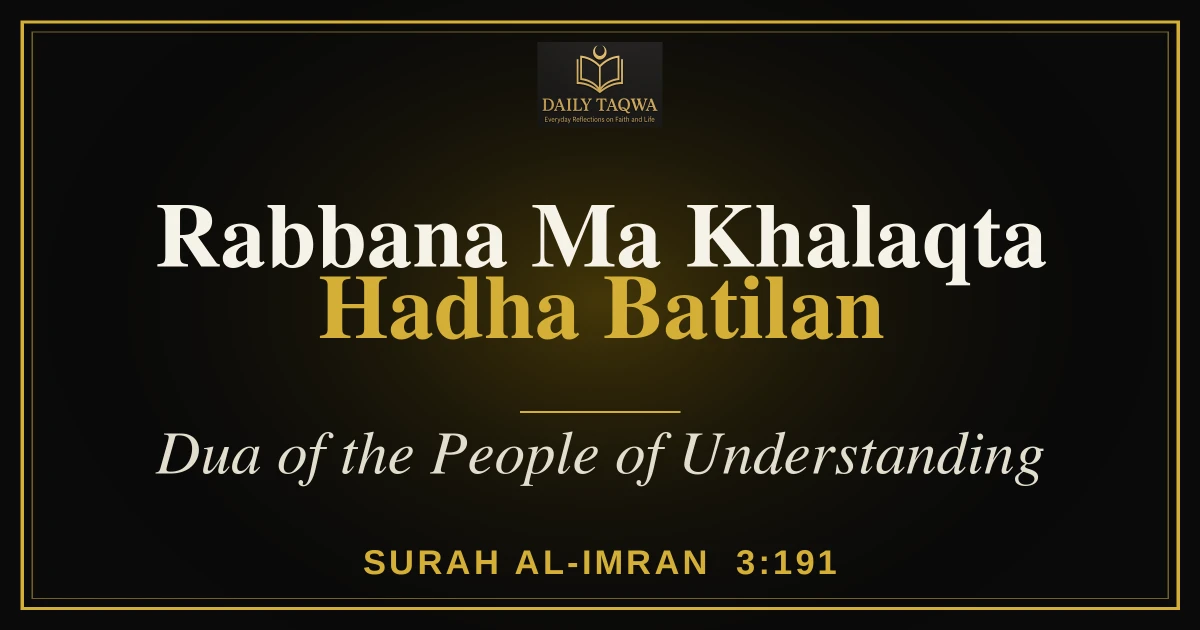
Rabbana ma khalaqta hadha batilan subhanaka faqina ‘adhaban-nar is a dua from Surah Al-Imran, verse 191. It means: ‘Our Lord, You did not create this without purpose. Glory be to You; so protect us from the punishment of the Fire.’
It is the dua of the people of understanding (ulul-albab). In the same verse, Allah describes them: they remember Him standing, sitting and lying on their sides, and they reflect on the creation of the heavens and the earth. Below you will find the Arabic, Roman English, Hindi and Urdu, the meaning of each word, who the people of understanding are, and the authentic Hadith about these verses.
رَبَّنَا مَا خَلَقْتَ هَٰذَا بَاطِلًا سُبْحَانَكَ فَقِنَا عَذَابَ النَّارِ
Roman English
Rabbanaa maa khalaqta haadhaa baatilan, subhaanaka faqinaa ‘adhaaban-naar.
Hindi (हिन्दी)
रब्बना मा ख़लक़्ता हाज़ा बातिलन, सुब्हानक फ़क़िना अज़ाबन्-नार।
ऐ हमारे रब! तूने यह सब बेकार नहीं बनाया, तू पाक है, तो हमें आग के अज़ाब से बचा ले।
Urdu (اردو)
اے ہمارے رب! تو نے یہ سب بے مقصد نہیں بنایا، تو پاک ہے، پس ہمیں آگ کے عذاب سے بچا لے۔
Meaning in English
Our Lord, You did not create this without purpose. Glory be to You; so protect us from the punishment of the Fire.
Quran Reference
- Surah: Al-Imran (Chapter 3), verse 191
- Read online: Quran 3:191 on Quran.com
- Context: Quran 3:190 to 3:194, the passage about the people of understanding and their duas
What Does Rabbana Ma Khalaqta Hadha Batilan Mean?
- Rabbana – our Lord
- Ma khalaqta – You have not created
- Hadha – this (the heavens and the earth)
- Batilan – in vain, without purpose
- Subhanaka – glory be to You, You are far above any fault
- Fa-qina – so protect us
- ‘Adhaban-nar – from the punishment of the Fire
Tafsir Ibn Kathir explains the end of the dua as: O You who created creation in truth and justice, and who are far above any shortcoming and above doing things without purpose or in jest, save us from the torment of the Fire with Your power and strength.
Notice the order of the dua. First comes reflection on creation. Then comes praise: ‘Subhanaka’. Only then comes the request: ‘protect us from the Fire’. Because creation has a purpose, we are responsible for how we live, and so we ask Allah for protection from the Fire.
Who Are the People of Understanding?
Quran 3:190 says that in the creation of the heavens and the earth and in the alternation of night and day there are signs for those of understanding. Quran 3:191 then describes them:
- They remember Allah while standing, sitting and lying on their sides. In other words, in every state.
- They reflect on the creation of the heavens and the earth.
- They say this dua.
Tafsir Ibn Kathir explains ‘the alternation of night and day’ as one following the other, with one becoming longer or shorter than the other at times, all by the decision of the Almighty, the Most Wise.
In the verses after this one, the same people make further duas (3:192 to 3:194).
What Does the Authentic Hadith Say?
This Hadith is about the verses that contain this dua. In Sahih Al-Bukhari 4570, Ibn Abbas (may Allah be pleased with him) said that he spent the night with his aunt Maymunah and wanted to watch the night prayer of the Messenger of Allah (peace and blessings be upon him). The Prophet (peace and blessings be upon him) slept, then woke up and wiped the sleep from his face with his hands. Then he recited the last ten verses of Surah Al-Imran until the end. In the narrations, the time is described as after about half the night, or in the last third of the night.
In Sahih Al-Bukhari 4569, Ibn Abbas adds that the Prophet (peace and blessings be upon him) looked up at the sky and recited the verse ‘Indeed, in the creation of the heavens and the earth and the alternation of the night and the day are signs for those of understanding’, then made wudu, used the siwak and prayed eleven rak’ahs. The Hadith is also recorded in Sahih Muslim.
References: Sahih Al-Bukhari 4570 and Sahih Al-Bukhari 4569
Benefits and Lessons
- Reflect before you ask. The dua comes after thinking about creation.
- Remember Allah in every state. The people of understanding remember Him standing, sitting and lying down.
- Nothing is created without purpose. In Quran 38:27, Allah says that He did not create the heaven and the earth and what is between them without purpose.
- Praise first, then ask. ‘Subhanaka’ comes before the request.
- Follow the example of the Prophet (peace and blessings be upon him). He looked up at the sky and recited these verses at night.
When Can I Make This Dua?
Allah invites us to call upon Him (Quran 40:60), so you can make this dua at any time. The Hadith in Sahih Al-Bukhari 4570 shows that the Prophet (peace and blessings be upon him) recited these verses when he woke up in the night.
Some people recommend reciting it every morning and evening. This is not verified as a fixed practice. It is still a good dua to make.
Frequently Asked Questions
What does Rabbana ma khalaqta hadha batilan mean?
It means: Our Lord, You did not create this without purpose. Glory be to You; so protect us from the punishment of the Fire. The people who say it first reflect on the creation of the heavens and the earth, then praise Allah, and then ask Him for safety from the Fire.
Where is Rabbana ma khalaqta hadha batilan in the Quran?
It is in Surah Al-Imran (Chapter 3), verse 191. The same verse also describes the people who say it.
Who says this dua in the Quran?
Quran 3:190 and 3:191 describe those of understanding (ulul-albab). They remember Allah standing, sitting and lying on their sides, and they reflect on the creation of the heavens and the earth. After that, they say this dua.
What does batilan mean in this dua?
Batilan means in vain or without purpose. Tafsir Ibn Kathir explains the dua as: O You who created creation in truth and justice, and who are far above doing things without purpose or in jest, save us from the torment of the Fire.
Why do we say subhanaka before asking for protection from the Fire?
Subhanaka means glory be to You. It declares that Allah is free from any fault, including creating anything without purpose. The believers praise Allah first and then make their request.
What did the Prophet do with these verses?
Ibn Abbas reported in Sahih Al-Bukhari 4570 that the Prophet (peace and blessings be upon him) woke up at night, wiped the sleep from his face, and recited the last ten verses of Surah Al-Imran, which begin with the verse about the creation of the heavens and the earth. Then he made wudu and prayed.
Is there a fixed reward or a special time for this dua?
We have not found an authentic Hadith that sets a number, a special time or a special reward for reciting only this dua. Some people recommend it every morning and evening. This is not verified as a fixed practice. You can make it at any time (Quran 40:60).
Are the Hindi and Urdu lines the Quran?
No. The Arabic is the word of Allah. The Roman English, Hindi and Urdu lines are only to help you read and understand. Please learn the correct pronunciation from a qualified teacher.
More Duas Asking for Protection from the Fire
- Rabbana Innana Amanna Faghfir Lana Dhunubana (Quran 3:16)
- Rabbana Atina Fid Dunya Hasanah (Quran 2:201)
References
- Quran 3:190–194, with the tafsir of Ibn Kathir – quran.com
- Quran 38:27 and 40:60
- Sahih Al-Bukhari 4570 – sunnah.com/bukhari:4570
- Sahih Al-Bukhari 4569 – sunnah.com/bukhari:4569
Conclusion
This dua teaches us to think about the creation of Allah, to praise Him, and then to ask Him for safety from the Fire. The Prophet (peace and blessings be upon him) used to recite these verses when he woke up at night.
May Allah make us among the people of understanding and protect us from the Fire. Ameen.